2024-11-29 · Fine-tuning, LLM
Low-Rank Adaptation (LoRA) was released by Edward Hu and his colleages at Microsoft. The paper was considered game-changing in natural language processing (NLP) field at the time due to its easy implementation and noticeable efficiency.
Nowadays, we rarely train a new model from scratch but to take an available pre-trained model and fine-tune it on our datasets. Despite that fine-tuning is significantly faster and less computationally expensive, the cost is still high, especially when model sizes grow.
To tackle that, Edward and his team proposed a technique to cleverly reduce computational cost without affecting the output of the fine-tuning process.
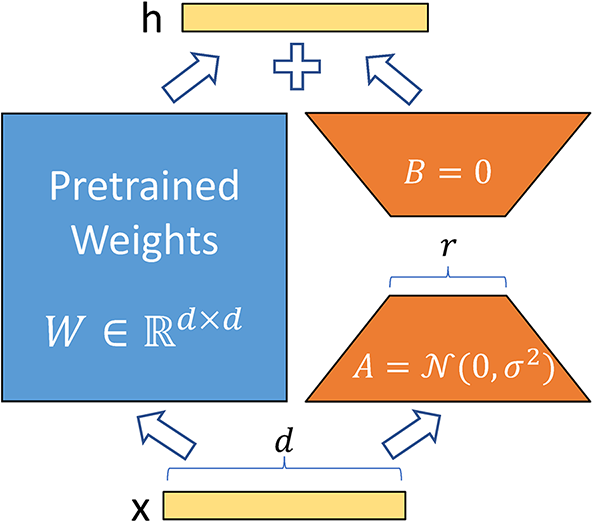
A neural network contains many dense layers which perform matrix multiplication. The weight matrices in these layers typically have full-rank. When adapting to a specific task, Aghajanyan et al. (2020) shows that the pre-trained language moels have a low "intrinsic dimension" and can still learn efficiently despite a random project to a smaller subspace. Taking advantage of this conclusion, Edward and his team applied it to the fine-tuning phase and found surprisingly good results. For a pre-trained weight matrix W_0 \in \mathbf{R}^{d \times k}, they limit its update by adding a component to weights of a layer.
In the formula above, the rank r \ll min(d, k).During training, W_0 is frozen and does not receive gradient updates, while A and B contain trainable parameters.
At the start of a fine-tuning scheme, A is sampled from a random Gaussian distribution while B is a zero matrix, so \Delta W = BA = \mathbf{0}. Additionally, a constant \frac{\alpha}{r} is introduced to the \Delta W. As the constant is not crucial to the fine-tuning, the authors set it to the first rank (r) at each experiment (They tried many ranks but kept \alpha fixed at the initial value).
Cited as:
Le Hoang Viet. "LoRA: Low-Rank Adaptation of Large Language Models". Le Hoang Viet's Homepage, November 2024. https://mikyx-1.github.io/blog/lora.html
Or the BibTeX entry:
@misc{le2024lora,
  title   = {LoRA: Low-Rank Adaptation of Large Language Models},
  author  = {Le, Hoang Viet},
  journal = {Le Hoang Viet's Homepage},
  year    = {2024},
  month   = {November},
  url     = {https://mikyx-1.github.io/blog/lora.html}
}
← Back to the blog index. Send feedback by email.